
Remembering Remarkable Women of WWII - August
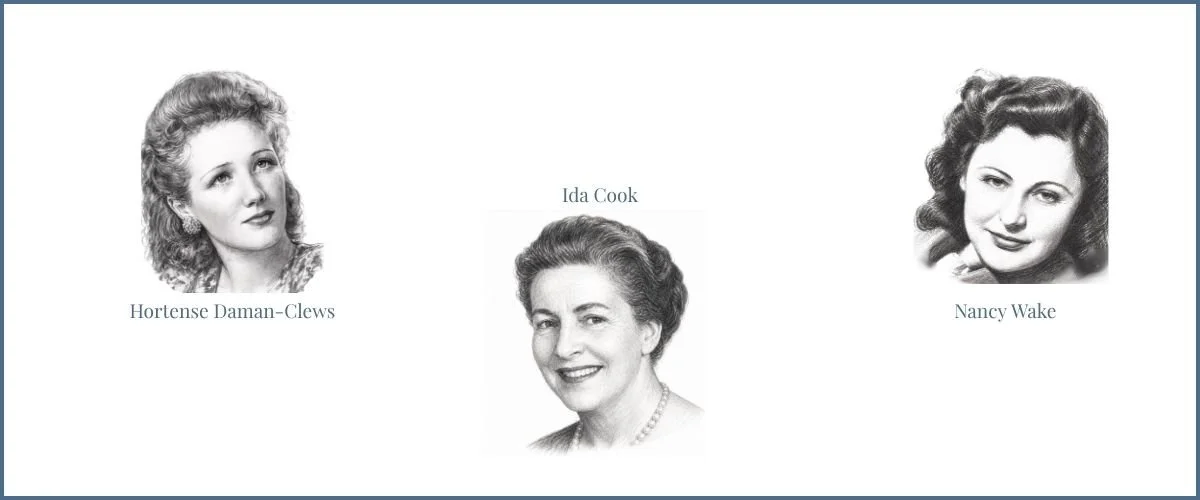
Each month, this series brings together a small selection of remarkable women from the Second World War. The women remembered here acted in very different circumstances — through resistance, humanitarian work, or quiet defiance — yet each demonstrated extraordinary courage in the face of danger. This August collection reflects on three such lives and the choices they made under occupation and war. Their stories deserve to be remembered.
Hortense Daman-Clews (1926-2006)
On 12th August 1926, Hortense Daman was born in Leuven, Belgium.
Hortense was just thirteen when Germany invaded Belgium in May 1940. Her elder brother, François, had already joined the resistance, and before long Hortense began helping too. She initially delivered food to hidden Allied soldiers and distributed underground newspapers under the cover of making deliveries for her family's grocery shop.
As the war continued, her missions became increasingly dangerous. Working as a courier, Hortense carried secret messages, important documents, weapons and explosives in the basket of her bicycle. On one occasion, she was stopped by German officers while carrying grenades hidden beneath eggs. Remaining remarkably calm, she offered the soldiers a couple of eggs, and they allowed her to continue on her way.
In February 1944, aged just seventeen, Hortense was arrested with her parents. Her brother escaped arrest, but Hortense endured weeks of interrogation as officers tried to discover his whereabouts. She gave nothing away.
Hortense was deported to Ravensbrück concentration camp, where she was subjected to brutal medical experiments. She survived the war and returned to Belgium in 1945.
After the war, Hortense married Sydney Clews, a Staff Sergeant in the British Army, and received numerous honours in recognition of her courage during the Second World War.
Hortense's story is an extraordinary reminder that even the very young could play a vital role in resisting oppression.
Ida Cook (1904–1986)
On 24th August 1904, Ida Cook was born in Sunderland, England.
Ida grew up to become a successful romance novelist, writing under the name Mary Burchell. But in the years before the Second World War, she and her elder sister, Louise, carried out a remarkable rescue mission.
The sisters were passionate opera lovers and regularly travelled from Britain to attend performances across Europe. Through friends in the opera world, they became increasingly aware of the persecution facing Jewish people in Nazi Germany and Austria—and decided they had to help.
Using their visits to the opera as cover, Ida and Louise made repeated journeys to European cities. They helped refugees obtain the documents, financial guarantees and accommodation they needed to enter Britain, while secretly carrying jewellery, furs and other valuables out of the country.
The sisters often returned home conspicuously dressed in the valuables they were carrying. They had a carefully rehearsed cover story if they were questioned—they were two nervous British spinsters who didn't trust their families at home and so took all their jewellery with them whenever they travelled. Their ordinary appearance became one of their greatest advantages—and time and again, they were underestimated.
Together, Ida and Louise helped 29 Jewish people escape Nazi persecution. Much of their work was funded by the money Ida earned from her novels.
In recognition of their courage, the sisters were later honoured by Yad Vashem as Righteous Among the Nations.
Ida’s story is a powerful reminder that extraordinary courage is often found in the most ordinary people.
Nancy Wake (1912–2011)
On 30th August 1912, Nancy Wake was born in Wellington, New Zealand.
Raised in Australia, Nancy later moved to Europe and worked as a journalist in Paris. When Germany invaded France, she initially worked as an ambulance driver before joining the Pat O’Leary escape network, helping Allied servicemen and others fleeing Nazi persecution cross the Pyrenees into Spain.
Her ability to evade capture earned her the Gestapo nickname "the White Mouse." Although she had several close escapes—often using her quick thinking and feminine charm to avoid suspicion—she was briefly arrested on one occasion. Albert Guérisse, leader of the escape line, persuaded officials that Nancy was his mistress and that they were trying to keep their relationship secret, securing her release.
By 1943, she had become one of the most wanted women in France and was forced to escape to Britain.
There, Nancy joined the SOE (Special Operations Executive). In April 1944, she parachuted back into occupied France, where she worked with resistance fighters in the Auvergne—helping organise supplies, maintain communications and prepare them for action against German forces.
In June 1944, shortly after D-Day, Nancy was with resistance fighters when the Germans attacked and they were forced to withdraw, leaving their radio equipment behind. Nancy cycled over 500 km in 72 hours to report back to London.
Her wartime courage earned her honours from Britain, France, the United States, Australia and New Zealand, making her one of the most highly decorated women of the Second World War.
Remembering Nancy Wake—bold, determined and famously fearless.