
Remembering Remarkable Women of WWII - January
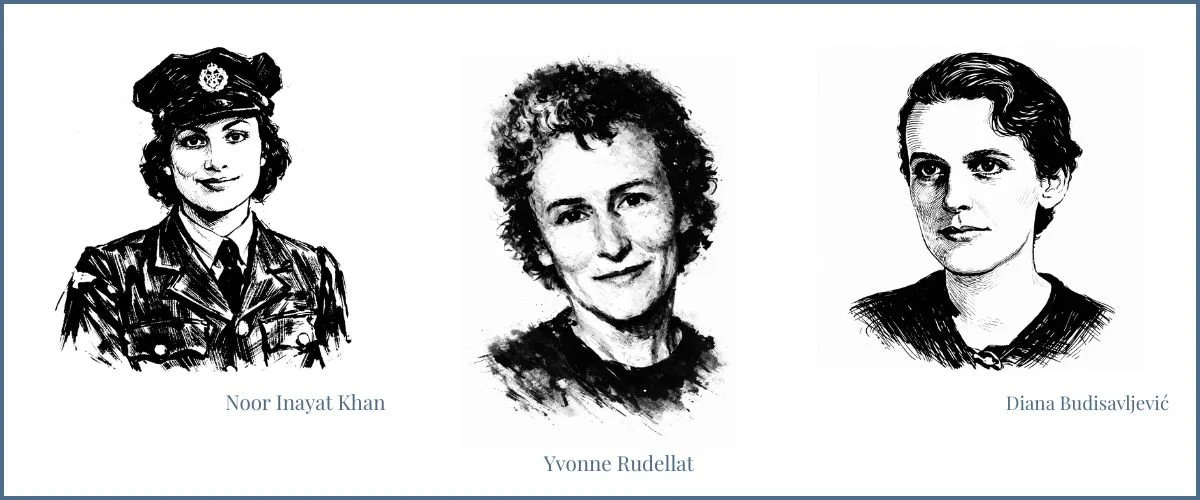
Each month, this series brings together a small selection of remarkable women from the Second World War. The women remembered here acted in very different circumstances — through resistance, humanitarian work, or quiet defiance — yet each demonstrated extraordinary courage in the face of danger. This January collection reflects on three such lives and the choices they made under occupation and war. Their stories deserve to be remembered.
Noor Inayat Khan (1914-1944) - SOE Wireless Operator
Noor Inayat Khan was born on 1 January 1914 in Moscow. The daughter of a Sufi teacher and musician, she grew up in a home shaped by pacifism, spirituality, and artistic expression. Her early years were spent in England before the family moved to France, where Noor studied music and child psychology and began writing, publishing poetry and children’s stories in both English and French.
Gentle and creative by nature, Noor was not an obvious candidate for wartime service. Yet when the Second World War broke out and France fell in 1940, she and her family fled back to Britain. Despite her deeply held belief in non-violence, Noor felt compelled to act. She joined the Women’s Auxiliary Air Force and was later recruited by the Special Operations Executive.
In 1943, she became the first female wireless operator sent into occupied France, operating under the codename Madeleine and using the cover of a nurse. Wireless operators were among the most vulnerable agents, forced to transmit messages while constantly moving to avoid detection. When the Prosper network was infiltrated by the Gestapo, Noor became, for a time, the sole remaining wireless link between Paris and London.
After more than three months in the field, she was betrayed and arrested. Despite harsh interrogation, Noor revealed nothing. She was eventually transferred to Dachau concentration camp, where she was executed in September 1944. She was 30 years old. Her final word was reported to be “Liberté.”
Posthumously awarded the George Cross and the Croix de Guerre, Noor Inayat Khan is remembered for her courage and the quiet resolve with which she faced extraordinary danger.
Yvonne Rudellat (1897-1945) - SOE Agent
Yvonne Claire Rudellat was born on 11 January 1897 near Paris, France. After her father’s death, she moved to London hoping to escape her overbearing mother. Her life in England was unsettled and challenging, marked by marriage, the birth of a daughter, separation, and periods of financial hardship.
When the Second World War broke out, Yvonne was determined to play an active role. Working as a secretary in London, she came to the attention of a recruitment officer from the Special Operations Executive. With her personal life in turmoil and her home recently damaged during the Blitz, the opportunity offered both a renewed sense of purpose and a way to contribute meaningfully to the fight against occupation in France.
In July 1942, after completing intensive training, Yvonne became the first female SOE-trained agent sent to occupied France. Considered too old for parachute training, she travelled by boat. Operating under the cover name Jacqueline Gautier, she worked closely with the French Resistance as a courier and organiser, coordinating supply drops, supporting resistance networks, and taking part in sabotage operations — all under constant threat of arrest and betrayal.
In June 1943, she and fellow agent Pierre Culioli were captured during a mission. Badly injured while attempting to evade arrest, Yvonne’s health deteriorated as she was transferred through a series of prisons and camps. In the final months of the war, she was held at Bergen-Belsen concentration camp, where she died of typhus and dysentery in April 1945, shortly after liberation. She was 36 years old.
For many months, Yvonne’s fate remained unknown. It was not until July 1946 that Vera Atkins traced her through a former Bergen-Belsen prisoner, who was able to confirm her death.
Posthumously awarded an honorary MBE, Yvonne Rudellat is commemorated on the Brookwood Memorial to the Missing, among those whose lives were lost to war without a known or honoured grave.
Diana Budisavljević (1891-1978) - Humanitarian and Child Rescuer
Diana Budisavljević was born on 15 January 1891. Raised in a wealthy Austrian family, she enjoyed a comfortable upbringing and later lived a high-society life in Zagreb after marrying a Serbian doctor. Given her circumstances, she could have lived through the war in relative comfort and safety.
However, in 1941, appalled by the conditions in which Serbian children were being held in camps run by the Ustaša regime, Diana felt compelled to help and began organising what became known as Action Diana Budisavljević. Initially, she hoped to help by raising funds, but the lack of official support and reliable networks soon made it clear that this alone was insufficient. Faced with the scale of suffering — particularly among children — Diana chose to assume a far more active and direct role.
Working with a small group of collaborators, she organised transport, secured food and medical supplies, negotiated access to camps, and oversaw the removal of children from conditions of extreme neglect and brutality. In time, Action Diana Budisavljević developed into one of the largest civilian child-rescue operations in wartime Europe.
Central to her work was meticulous documentation. Diana recorded names, birth dates, places of origin, and destinations wherever possible, hoping that children might one day be reunited with surviving family members after the war. The lists she compiled are considered among the most comprehensive records created in the region during this period, preserving identities that might otherwise have been lost.
Through her efforts, an estimated 10,000–12,000 children were rescued. Yet for decades, Diana’s work remained largely unrecognised, in part due to the complex political situation in the region after the war. Today, she is remembered as an extraordinary example of civilian courage — a woman who stepped far beyond the boundaries of her own privileged life to protect the most vulnerable.
Further reading: Diana Budisavljević’s remarkable story is explored in Saving the Children of the Holocaust.