
Remembering Remarkable Women of WWII - February
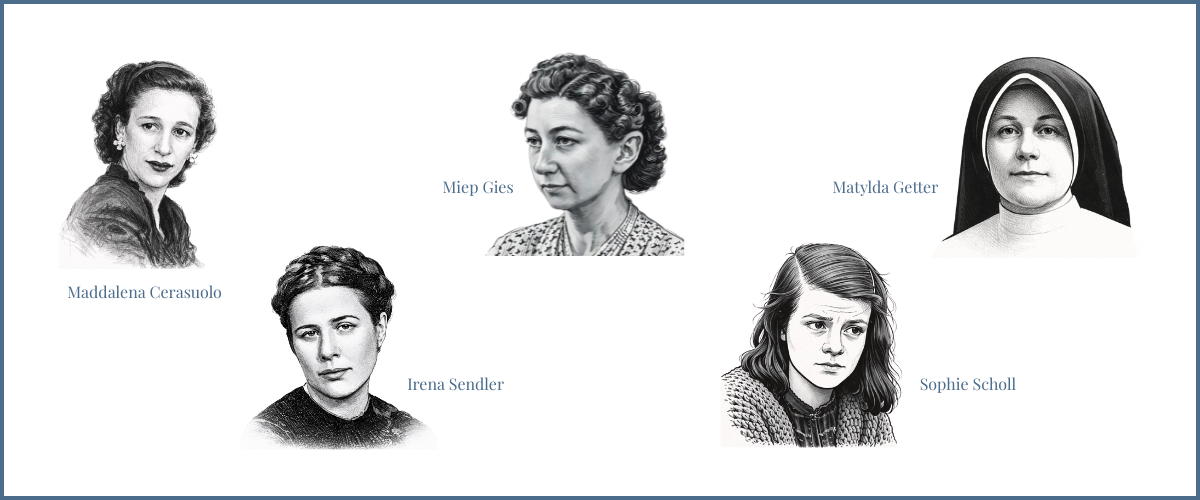
Each month, this series brings together a small selection of remarkable women from the Second World War. The women remembered here acted in very different circumstances — through resistance, humanitarian work, or quiet defiance — yet each demonstrated extraordinary courage in the face of danger. This February collection reflects on five such lives and the choices they made under occupation and war. Their stories deserve to be remembered.
Maddalena Cerasuolo (1920-1999)
On 2 February 1920, Maddalena Cerasuolo was born in Naples
Maddalena grew up in a working-class family shaped by opposition to the Fascist regime. Her father, an outspoken anti-fascist, was frequently placed under surveillance and repeatedly arrested during Mussolini’s rule. Before the war, Maddalena worked in a shoe factory and had never travelled beyond her native city.
In September 1943, following the German occupation of Naples, Maddalena took part in the civilian uprising later known as the Four Days of Naples, one of the few successful popular revolts against Nazi control in occupied Europe. During the fighting, she played a decisive role in defending the Ponte della Sanità, helping to prevent German forces from destroying the bridge with explosives as they retreated. After the war, in recognition of her actions, the bridge was named in her honour, and she was awarded the Bronze Medal for Military Valour.
Maddalena’s courage and clear judgment brought her to the attention of the British Special Operations Executive, and she was recruited as an agent. Maddalena operated under the code names Maria and Anna Esposito, and was identified internally as C22. Her assignments included dangerous sea crossings by night aboard a submarine to make contact with partisan fighters, attempts to infiltrate enemy-held territory, and work as a courier in Rome, where intelligence gathered through discreet social connections was passed to the Allies. She also undertook missions in the Montecassino area and witnessed the devastation caused by the bombing of the historic monastery.
Throughout her life, she remained steadfast in her anti-fascist convictions, shaped in part by her father’s example. Maddalena Cerasuolo’s story stands as a testament to the role ordinary citizens played in the struggle against occupation and dictatorship.
Irena Sendler (1910-2008)
On 15 February 1910, Irena Sendler was born.
Irena was a Polish social worker whose efforts during the German occupation of Warsaw saved the lives of thousands of Jewish children. Working with the Polish resistance and the Council to Aid Jews (Żegota), she organised the rescue of children from the Warsaw Ghetto, arranging false documents, safe houses, and placements in convents, orphanages, and private homes.
Sendler carefully recorded the children’s real names and new identities, sealing the lists in jars and burying them in the hope that families might one day be reunited. Arrested by the Gestapo in 1943, she was tortured but refused to betray her colleagues or the children in her care. Sentenced to death, she narrowly escaped execution after Żegota bribed a guard. She spent the remainder of the war in hiding.
After the war, Irena was recognised by Yad Vashem as Righteous Among the Nations, honouring her role in saving Jewish lives at immense personal risk.
Her life reflects the moral resolve of those who chose to act, quietly and persistently, in defence of the vulnerable.
For further reading, Irena’s remarkable story is explored in Saving the Children of the Holocaust.
Miep Gies (1909-2010)
On 15 February 1909, Miep Gies was born in Vienna.
Born Hermine Santrouschitz, she moved to the Netherlands as a child to recover from ill health, became known as Miep, and eventually made Amsterdam her permanent home.
In 1933, she began working for Otto Frank, initially assisting with the production of pectin for jam-making before becoming an office secretary. Through this work she and her husband, Jan Gies, became close to the Frank family.
As the Nazis intensified their anti-Jewish measures in the Netherlands, Miep agreed to help hide Otto Frank, his wife Edith, their daughters Margot and Anne, and four others in concealed rooms behind the office building on Prinsengracht. The hiding place later became known as the Secret Annex. For more than two years, Miep and a small group of trusted helpers provided food, supplies, and news from outside, fully aware that their actions could lead to severe punishment or death.
In August 1944, the Annex was betrayed and its occupants arrested. Miep avoided detention, reportedly because the German officer present was from Vienna. After the arrests, she returned to the empty rooms and gathered Anne Frank’s notebooks and loose papers, keeping them safe in the hope of returning them to her after the war.
Following the war, she gave the manuscripts to Otto Frank, the only surviving member of the group. These writings were later published as The Diary of Anne Frank, one of the most widely read personal accounts of the Holocaust.
Throughout the occupation, Miep Gies did what she could to help protect and save Jewish lives, despite the risks she faced. She did not regard herself as extraordinary, yet her actions ensured that one young voice would endure.
Sophie Scholl (1921-1943)
On 22 February 1943, Sophie Scholl was executed.
Sophie was born on 9 May 1921 in Forchtenberg, Germany, into a family that encouraged independent thought and moral responsibility. As the National Socialist regime tightened its grip on German society, she became increasingly troubled by its repression and violence.
While studying biology and philosophy at the University of Munich, she joined her brother Hans and a small group of students in the White Rose, a non-violent resistance movement. The group wrote and distributed leaflets denouncing the persecution and murder of Jewish people, criticising the war, and urging Germans to resist tyranny. Because she attracted less suspicion as a young woman, Sophie played an active role in transporting and distributing the pamphlets.
On 18 February 1943, she and Hans were discovered scattering leaflets inside the university building. They were arrested by the Gestapo and, during interrogation, accepted responsibility in an attempt to shield other members of the group. Four days later, Sophie was tried by the People’s Court, convicted of treason, and executed by guillotine at Stadelheim Prison at the age of twenty-one. Hans Scholl and Christoph Probst were executed the same day.
Copies of the White Rose leaflets were later smuggled out of Germany. Their text was reproduced by the Allies and distributed widely, ensuring that their words reached far beyond the university halls where they had first been cast into the air.
Sophie Scholl’s legacy rests not in armed struggle, but in the written word and the conviction that conscience must prevail over fear.
Matylda Getter (1870-1968)
On 25 February 1870, Matylda Getter was born in Warsaw.
Matylda joined the Franciscan Sisters of the Family of Mary, eventually becoming Mother Provincial of the order in the Polish capital. Before the outbreak of war, her work centred on education, social welfare, and the care of vulnerable children. In recognition of these efforts, she received several national distinctions.
During the German occupation of Poland, Mother Matylda instructed the sisters under her authority to provide assistance wherever it was needed, despite the grave dangers involved. Working in cooperation with members of the Polish underground and the rescue organisation Żegota, she helped arrange shelter for both adults and children fleeing persecution.
Convents, orphanages, schools, and care homes run by her order became places of refuge. Many Jewish children rescued from the Warsaw Ghetto by Irena Sendler were transferred to institutions under Getter’s supervision. There, they were provided with false identities and raised under the protection of the sisters. She is credited with helping to save hundreds of children, though the precise number cannot be known.
Matylda Getter survived the war and continued her religious and charitable work in post-war Poland until her death in 1968. She was later recognised by Yad Vashem as Righteous Among the Nations.
Her life illustrates how institutional leadership, guided by moral clarity, could become a quiet instrument of rescue in a time of systematic persecution.