
Remembering Remarkable Women of WWII - March
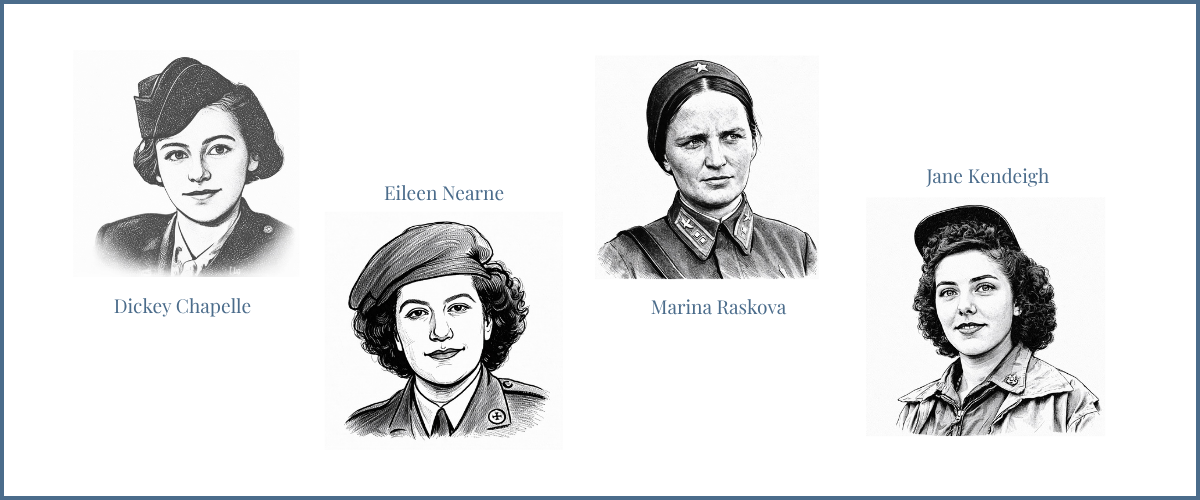
Each month, this series brings together a small selection of remarkable women from the Second World War. The women remembered here acted in very different circumstances — through resistance, humanitarian work, or quiet defiance — yet each demonstrated extraordinary courage in the face of danger. This March collection reflects on four such lives and the choices they made under occupation and war. Their stories deserve to be remembered.
Dickey Chapelle (1918–1965)
On 14 March 1918, Dickey Chapelle was born Georgette Louise Meyer in Shorewood, Wisconsin, United States.
From an early age, she was drawn to aviation, earning a scholarship to study aeronautical design. She eventually chose to pursue flying rather than designing aircraft, leaving the course to focus on aviation. After working in various roles in Florida, Chapelle moved to New York and studied photography under Tony Chapelle, a TWA publicity photographer whom she later married. Her skills and determination led her into journalism, where she became one of the first American women to report from front-line combat.
During the Second World War, Chapelle covered battles in the Pacific theatre, including Iwo Jima and Okinawa, accompanying U.S. Marines. After the war, she continued reporting from conflict zones worldwide, maintaining close contact with the people living through events. In 1956, while covering the Hungarian Revolution, she was captured and imprisoned for over seven weeks but returned to reporting after her release. By the 1960s, Chapelle was again on the front lines in Vietnam, accompanying troops on patrols.
Dickey Chapelle was killed by shrapnel from a tripwire booby trap in South Vietnam in 1965, becoming the first American female war correspondent to die in combat.
Dickey Chapelle’s was one of the first American women to report from the front lines of war and her work set a standard for front-line reporting that combined courage with professional commitment.
Eileen Nearne (1921–2010)
On 15 March 1921, Eileen Nearne was born in London, England.
She spent much of her childhood in France and became bilingual in French and English, skills that later proved essential for her work with Britain’s Special Operations Executive (SOE) during the Second World War. After escaping occupied France in 1940, she joined the First Aid Nursing Yeomanry (FANY) in England before being recruited by the SOE. She initially worked as a signals operator, decoding secret messages sent by agents in the field.
In March 1944, Nearne was deployed to occupied France as a wireless operator under the code name Rose, maintaining vital communication between resistance groups and London. Wireless operators faced extreme danger, as German forces actively tracked transmissions, forcing operators to move frequently to new locations.
In July 1944, she was arrested. Despite interrogation and torture, she revealed nothing of significance. Nearne was deported to Ravensbrück concentration camp and later transferred to a labour camp in Silesia. In April 1945, she escaped with two other women and remained in hiding until liberated by Allied forces. She was awarded the MBE and the Croix de Guerre for her service.
Eileen Nearne’s work exemplifies the extraordinary skill and resilience required of clandestine operatives sustaining resistance networks under constant threat.
Marina Raskova (1912–1943)
On 28 March 1912, Marina Raskova was born in Moscow, Russia.
Originally drawn to music, Raskova turned to aviation after an ear infection prevented her from pursuing singing as a career. Marina became the first woman in the Soviet Union to earn a professional air navigator’s diploma and later the first female instructor at the Zhukovsky Air Academy. In 1938, she gained national recognition as the navigator on the record-breaking long-distance flight of the aircraft Rodina.
Following the German invasion of the Soviet Union in 1941, thousands of women pilots volunteered to fly — and Marina pushed relentlessly for them to be accepted. Using her influence at the highest levels, she helped establish three all-female aviation regiments, including the night bomber unit later known as the Night Witches. She oversaw recruitment and training, ensuring that women served as pilots, navigators, mechanics, and ground crew rather than only in auxiliary roles.
Marina Raskova died in a plane crash near Stalingrad in 1943.
Marina is remembered as the driving force behind the Soviet Union’s all-female combat air regiments and a pioneering aviator whose courage and influence helped open the skies to women in wartime.
Jane Kendeigh (1922–2012)
On 30 March 1922, Jane Kendeigh was born in Ohio, United States.
Jane trained as a nurse before joining the U.S. Navy during the Second World War. Selected for the Navy’s new air-evacuation programme, she trained to care for battlefield casualties in flight under combat conditions.
In 1945, during the battles of Iwo Jima and Okinawa, Kendeigh became the first Navy flight nurse to serve in an active combat zone, evacuating wounded servicemen from the front lines. Navy flight nurses were responsible for the medical care of thousands of injured personnel during aerial transport, providing essential support under combat conditions.
Jane Kendeigh is remembered as a pioneering flight nurse, who helped bring the wounded home from the front.