
Remembering Remarkable Women of WWII - April
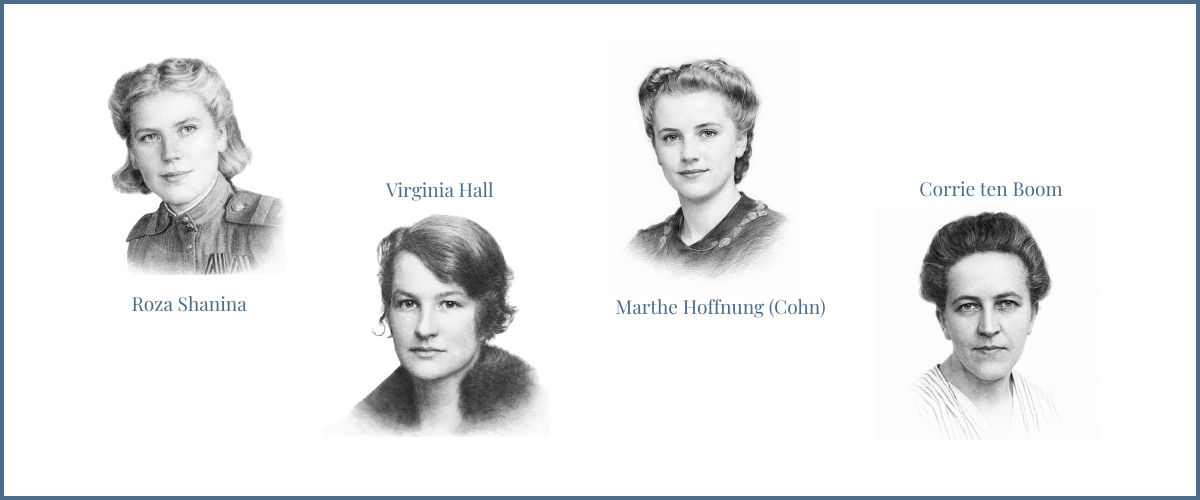
Each month, this series brings together a small selection of remarkable women from the Second World War. The women remembered here acted in very different circumstances — through resistance, humanitarian work, or quiet defiance — yet each demonstrated extraordinary courage in the face of danger. This April collection reflects on four such lives and the choices they made under occupation and war. Their stories deserve to be remembered.
Roza Shanina (1924–1945)
On 3 April 1924, Roza Shanina was born in Edma, in northern Russia.
Roza grew up in a rural family as one of seven siblings. When Germany invaded the Soviet Union in 1941 and bombed her town, Shanina contributed to local defence efforts, helping to fight fires and taking part in rooftop vigils to protect the kindergarten where she worked. Following the death of one of her brothers during the siege of Leningrad, she sought permission to join the war effort. After several months, she was accepted into the Central Women’s Sniper Training School and became a sniper in the Red Army.
Shanina served on the Eastern Front, where she built a reputation for accuracy and determination. Credited with more than fifty confirmed kills, she took part in operations including the Battle of Vilnius. In December 1944, she was wounded in the shoulder by enemy fire but returned to duty within weeks. Alongside her military service, she kept a wartime diary, providing a rare personal account of life at the front.
Roza was killed in action on 28 January 1945 during the East Prussian Offensive. She was twenty years old.
Roza Shanina’s service reflected the changing role of women within the Soviet armed forces — stepping into a role long reserved for men, and proving she belonged there.
Virginia Hall (1906–1982)
On 6 April 1906, Virginia Hall was born in Baltimore, Maryland, United States.
Virginia was an ambitious young American who dreamed of a diplomatic career. But after a hunting accident in Turkey led to the amputation of part of her left leg, she was rejected by the U.S. Foreign Service — a setback that might have ended many ambitions, but not hers.
When war broke out, Virginia joined the French ambulance service and, after the fall of France, made her way to Britain, where she volunteered for the Special Operations Executive (SOE).
Sent into occupied France under the cover of a journalist for the New York Post, she organised resistance networks, helped downed airmen and escaped prisoners, arranged safe houses, and stayed one step ahead of the Gestapo, who referred to her as “the Limping Lady.”
One of the most remarkable chapters of her story came when she escaped France by crossing the Pyrenees on foot, enduring immense pain on her wooden leg — which she had nicknamed “Cuthbert.”
Considered too well known to return by the SOE, Virginia later re-entered France with the OSS, disguised as an elderly peasant woman. Working behind enemy lines, she helped coordinate sabotage operations, scout drop zones, and support resistance fighters in the lead-up to D-Day.
Virginia also carried out wireless work — one of the most dangerous roles in occupied France — while German forces continued their efforts to capture her.
For her wartime service, Virginia Hall was awarded the Distinguished Service Cross, becoming one of the very few civilian women to receive one of America’s highest honours for bravery.
Her story remains one of the most extraordinary examples of courage and resilience during the war — a woman dismissed by the diplomatic world who went on to become one of the Allies’ most valuable agents, and one the Gestapo never managed to catch.
Marthe Hoffnung Cohn (1920–2025)
On 13 April 1920, Marthe Hoffnung Cohn was born in Metz, France.
She grew up in an Orthodox Jewish family in a region shaped by shifting borders, becoming fluent in both German and French. Shortly before France declared war on Germany, her family relocated to Poitiers, where they became involved in resistance efforts, assisting those seeking to escape occupied France.
Cohn trained as a nurse, but following the deaths of her sister and fiancé, she sought a more direct role in the war effort.
At first, she was considered unsuitable for dangerous operations. But a French Resistance colonel soon recognised something others had overlooked: this young, blonde, petite woman who spoke flawless German could move through enemy territory without attracting suspicion.
Posing as a German nurse searching for a missing fiancé, Cohn crossed into Nazi Germany and gathered information from soldiers and officers. Under this cover, she gathered vital information from German soldiers and officers, often placing herself in extraordinary danger.
Her intelligence contributed to Allied operations during the final months of the war, including reports on German troop positions in the Black Forest.
After the war, Marthe Hoffnung Cohn received some of France’s highest military honours, including the Croix de Guerre, the Médaille militaire, and the Legion of Honour. She was also awarded the Order of Merit of the Federal Republic of Germany.
For many years, she spoke little about her wartime experiences, only sharing her story publicly later in life.
Her story is a remarkable reminder that some of the most important wartime acts were carried out not by famous generals or political leaders, but by ordinary people willing to step quietly into extraordinary danger.
Corrie ten Boom (1892–1983)
On 15 April 1892, Corrie ten Boom was born in Haarlem, the Netherlands.
Corrie grew up in a deeply religious family whose Christian faith shaped a strong commitment to helping others.
Before the war, Corrie worked in her father’s watch shop and became the first woman licensed as a watchmaker in the Netherlands.
During the German occupation, as restrictions and persecution intensified, Corrie and her family joined the Dutch Resistance. Their home above the watch shop became part of a resistance network, providing shelter to Jewish people and others at risk. A secret room was built into Corrie’s bedroom, where those in danger could be concealed during raids.
Corrie also helped secure ration cards and became part of a wider underground network moving Jewish people to safer locations.
In February 1944, the ten Boom family was betrayed. Corrie, her sister Betsie, and their father Casper were arrested. Despite the raid, the people hidden inside the secret room were never discovered and survived.
Corrie’s father died in captivity just ten days later. Corrie and Betsie were sent to Ravensbrück concentration camp, where, despite brutal conditions, they continued to encourage and support others through their faith. Betsie died there in December 1944.
Shortly afterwards, Corrie was released due to what was later described as a clerical error — only weeks before women of her age group were sent to the gas chambers.
After the war, Corrie dedicated her life to speaking about faith, forgiveness, and resilience. She later recorded her experiences in her well-known memoir, The Hiding Place.
Corrie ten Boom was eventually honoured by Yad Vashem as one of the Righteous Among the Nations for her role in helping save Jewish lives during the Holocaust.
Corrie’s life was shaped by an unshakable Christian faith that led her to protect others during the darkest years of the war and gave her the strength to share a message of faith, forgiveness, and hope in the years that followed.