
Remembering Remarkable Women of WWII - May
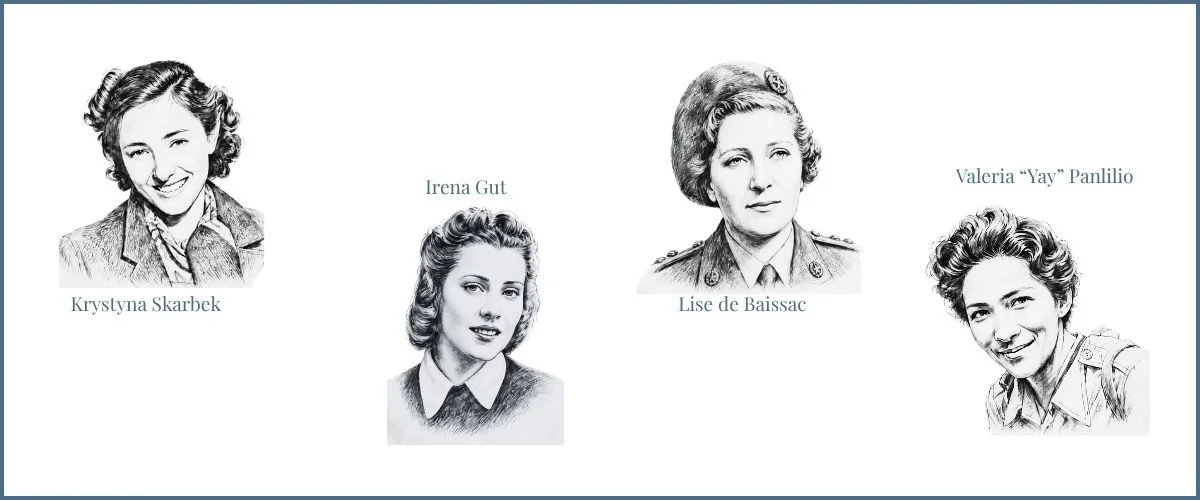
Each month, this series brings together a small selection of remarkable women from the Second World War. The women remembered here acted in very different circumstances — through resistance, humanitarian work, or quiet defiance — yet each demonstrated extraordinary courage in the face of danger. This May collection reflects on four such lives and the choices they made under occupation and war. Their stories deserve to be remembered.
Krystyna Skarbek (1908–1952)
On 1 May 1908, Krystyna Skarbek was born in Warsaw, Poland.
The daughter of a Polish aristocrat and a mother from a Jewish banking family, Skarbek grew up with a strong sense of independence and a love of outdoor pursuits, particularly horse riding and skiing. Following the German invasion of Poland in 1939, she offered her services to Britain and became one of the earliest female agents to undertake intelligence work in the field. She initially worked for the Secret Intelligence Service (SIS) before transferring to the Special Operations Executive (SOE).
Her wartime work took her across occupied Europe and the Middle East, carrying intelligence and undertaking dangerous missions. Among her achievements was providing early information regarding Germany's planned invasion of the Soviet Union. She crossed heavily guarded borders, escaped imprisonment by feigning tuberculosis, and was once smuggled out of Hungary in the boot of a British Embassy car. In 1944, she played a crucial role in securing the release of SOE operative Francis Cammaerts and two fellow agents who were facing execution by German forces.
Often described as one of Britain's most effective wartime agents, she became known for her resourcefulness and willingness to take risks.
After the war, Skarbek received several honours, including the OBE and the George Medal. Like many former agents, she found the transition to civilian life difficult.
In June 1952, her life was tragically cut short when she was murdered by a man who had become obsessed with her.
Krystyna Skarbek - a fearless woman who risked everything in the fight against Nazi occupation.
Irena Gut (1922–2003)
On 5 May 1922, Irena Gut was born in Kozienice, Poland.
She grew up in a close-knit Polish family and initially hoped to to become a nun, but her father encouraged her to train as a nurse instead — plans that were cut short by the outbreak of war.
The region where Irena lived was first occupied by the Soviet Union. She went into hiding but was eventually discovered and subjected to brutal treatment. After escaping and hiding in a forest, she was captured once again.
Following the German invasion of the Soviet Union in 1941, the area came under Nazi occupation. Irena was sent to work in a munitions factory, but when the Germans realised she spoke fluent German, she was transferred to a hotel occupied by German officers.
There, she became friends with several Jewish workers in the hotel's laundry. As persecution intensified, Irena was determined to help — smuggling food into the ghetto and delivering supplies to those hiding in the surrounding forests.
Irena was later assigned as housekeeper to Wehrmacht Major Eduard Rügemer. There, at great personal risk, she secretly sheltered 12 Jewish men and women in the cellar of his home.
When Rügemer discovered what Irena was doing, he agreed to keep her secret on the condition that she became his mistress — a burden she carried long after the war. All twelve survived the war.
After the war, she emigrated to the United States, where she married William Opdyke, a UN worker she met in a Displaced Persons camp in Germany.
In recognition of her courage, she was later honoured as Righteous Among the Nations by Yad Vashem.
Irena Gut Opdyke - a woman who chose to act — and paid a deeply personal price.
Lise de Baissac (1905–2004)
On 11 May 1905, Lise de Baissac was born in Mauritius.
During the Second World War, she joined the Special Operations Executive, becoming one of the first female agents to be sent into occupied France.
In September 1942, she was parachuted into France, where she worked as a courier and organiser, helping to establish and support resistance networks. Living under constant threat, she travelled widely, gathering intelligence and maintaining vital contacts.
Using the cover of an amateur archaeologist, she cycled through the countryside searching for “ancient sites”, while in reality identifying potential parachute drop zones and landing areas.
When her network was compromised in the summer of 1943, she returned to Britain.
In April 1944, she went back to France ahead of the D-Day landings, working with her brother Claude in the Scientist network. Often travelling long distances by bicycle, she carried crucial messages and helped support resistance activity in the lead-up to the Allied invasion.
After the war, Lise was awarded the MBE and the Croix de Guerre in recognition of her service.
Lise de Baissac - a woman whose work behind enemy lines helped prepare the way for liberation.
Valeria "Yay" Panlilio (1913–1978)
On 22 May 1913, Valeria "Yay" Panlilio was born in Denver, Colorado, United States.
Born in May 1913 to a Filipina mother and an Irish-American father, she later moved to the Philippines with her husband, where she became a newspaper journalist and radio broadcaster. The couple had three children.
As war approached, her reporting brought her to the attention of U.S. Army intelligence. After the Japanese occupation of Manila, she used her position as a broadcaster to pass coded messages and support the Allied resistance.
In March 1942, after making a final radio broadcast expressing support for the Allies, an order was issued for her arrest. Forced into hiding, she fled Manila and later joined the Marking Guerrillas, a Filipino resistance group fighting Japanese occupation on Luzon. Her children went into hiding, cared for by an elderly American couple.
Known as “Colonel Yay,” she became second in command, regarded as the brains behind the operation. Her contribution was so significant that a regiment was later named in her honour. Although not personally involved, the Yay regiment joined American forces in an operation to prevent the destruction of the Ipo Dam, a key water source for Manila.
In February 1945, Panlilio left the guerrilla movement and returned to Manila. A few months later, she travelled back to the United States with her three children.
After the war, she published her memoir, The Crucible: An Autobiography by Colonel Yay, Filipina American Guerrilla, and was awarded the Medal of Freedom by President Harry S. Truman.
Valeria “Yay” Panlilio — a courageous, intelligent woman who played a remarkable role in the Philippine resistance.