
Remembering Remarkable Women of WWII - June
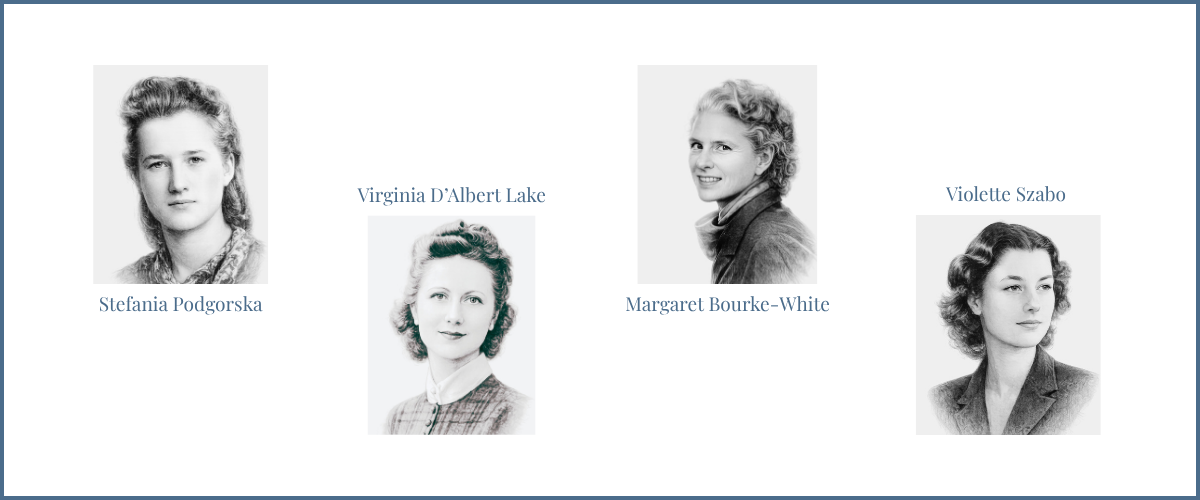
Each month, this series brings together a small selection of remarkable women from the Second World War. The women remembered here acted in very different circumstances — through resistance, humanitarian work, or quiet defiance — yet each demonstrated extraordinary courage in the face of danger. This June collection reflects on four such lives and the choices they made under occupation and war. Their stories deserve to be remembered.
Stefania Podgórska (1921–2018)
On 2 June 1921, Stefania Podgórska was born near Przemyśl, Poland.
She grew up in a Catholic farming family and spent her early years in the countryside. At the age of fourteen, she persuaded her mother to allow her to move to the nearby city of Przemyśl, where two of her older sisters were already living. There, she found employment with the Diamant family, a Jewish family who were kind to her and welcomed her into their lives. Before long, she was living with them and helping with domestic responsibilities.
Following the German occupation of the city, the Diamants were forced into the ghetto. They asked Stefania to stay at their house and look after it - hoping they would soon return. As deportations and persecution intensified, Maksymilian Diamant sought Stefania's help. Together with her younger sister Helena, she agreed to shelter members of the family and others who were in danger. The sisters rented a small house on the outskirts of Przemyśl and concealed thirteen Jewish men, women, and children in the attic. Stefania worked long hours in a factory to obtain food and supplies, while Helena assisted in caring for those in hiding. The risks were considerable, particularly when German nurses and their companions moved into part of the same house, unaware that thirteen people were concealed above them.
Despite repeated dangers and several close calls, the sisters continued to protect those in their care. When Przemyśl was liberated in July 1944, all thirteen people hidden by Stefania and Helena had survived.
After the war, Stefania married Maksymilian Diamant, later known as Josef Burzminski.
In 1979, both sisters were recognised by Yad Vashem as Righteous Among the Nations.
Stefania Podgórska's actions demonstrate the capacity of ordinary individuals to make life-saving choices under extraordinary circumstances.
Virginia d'Albert-Lake (1910–1997)
On 4 June 1910, Virginia Roush was born in Dayton, Ohio, United States.
While travelling in France, she met Philippe d'Albert-Lake, whom she later married. Although they married in Florida, the couple chose to make their home in France. Following the German invasion of France in 1940, Virginia remained with her husband despite her parents encouraging her to return to the United States. She was determined to stay with Philippe.
The couple divided their time between Paris and a cottage in Nesles. There, they were approached by a local baker who was sheltering Allied airmen and needed someone fluent in English to communicate with them. This introduction led to their involvement with the Comet Line, one of the most important escape networks operating in occupied Europe. Virginia helped identify genuine Allied airmen, provided shelter, and assisted in guiding them along routes that could ultimately return them to Britain. Together, she and Philippe helped approximately sixty-seven airmen evade capture.
In June 1944, shortly after the Normandy landings, Virginia was arrested while escorting airmen to a safe location. During her transfer to Gestapo headquarters, she destroyed sensitive information by tearing it into pieces and swallowing it. Despite repeated interrogations, she revealed nothing about the network's operations. After imprisonment in France, she was deported to Ravensbrück concentration camp, where she remained until liberation in 1945.
Following the war, she received several honours, including the Medal of Freedom, the OBE, and the Croix de Guerre.
Virginia d'Albert-Lake's work illustrates the vital contribution of civilian escape networks in supporting Allied personnel trapped behind enemy lines.
Margaret Bourke-White (1904–1971)
On 14 June 1904, Margaret Bourke-White was born in the Bronx, New York, United States.
She became one of the most influential photojournalists of the twentieth century, building a career that combined technical skill with a willingness to work in challenging and often dangerous environments. Her photographs documented industry, urban life, political change, and conflict. In 1936, her image of Fort Peck Dam appeared on the first cover of LIFE magazine, where she became the publication's first female photojournalist.
During the Second World War, Bourke-White achieved a number of notable firsts. She became the first American female war photojournalist accredited with the United States Army Air Forces and was the only foreign photographer present in Moscow when Germany launched its invasion of the Soviet Union in 1941. Throughout the war, she accompanied military operations, flew on bombing missions, and worked close to active combat zones. She later travelled through Germany with General George Patton's Third Army as Allied forces advanced into the heart of the Reich.
In 1945, Bourke-White photographed the liberation of Buchenwald concentration camp. The images she produced became some of the most widely recognised visual records of Nazi atrocities and helped inform international audiences about conditions within the camps. Throughout her career, she consistently placed herself where significant events were unfolding, using photography to document moments of historical importance.
Margaret Bourke-White's work helped shape modern photojournalism and remains an important visual record of the twentieth century.
Violette Szabo (1921–1945)
On 26 June 1921, Violette Bushell was born in Paris, France.
Born Violette Bushell on 26 June 1921, she was the daughter of a British father and a French mother. Bilingual from childhood, she spent her early years living in both France and England.
In 1940, she met Étienne Szabo, an officer in the French Foreign Legion, at a Bastille Day parade in London. They married after a short courtship, and in June 1942, Violette gave birth to their daughter, Tania. Tragically, Étienne was killed later that year during the Battle of El Alamein.
Étienne’s death fuelled Violette’s determination to fight the enemy who had taken him from her. She joined the Special Operations Executive and was sent into occupied France. Her first mission was to assess the damage done to the Salesman network following a series of arrests. On her return to Britain, the aircraft carrying her came under enemy fire, but landed safely.
On Violette’s second mission, shortly after D-Day, she was captured while travelling with members of the Resistance. Accounts of her arrest vary, with some describing how she twisted her ankle while attempting to escape. Rather than surrender immediately, Violette reportedly fought the Germans, allowing her companion to escape to safety.
Violette was interrogated, tortured, and deported to Ravensbrück concentration camp. There, she became part of a group of women who refused to work in a munitions factory and, as a result, were subjected to brutal treatment and harsh labour. Accounts from fellow prisoners suggest that Violette initially remained optimistic and often spoke of escaping, but months of abuse and exhaustion gradually took their toll.
In early 1945, aged just 23, she was executed. After the war, she was posthumously awarded the George Cross and the Croix de Guerre.
Violette Szabo - a young woman who paid the ultimate price in the fight against Nazi occupation..